
Table of Contents
How the PMP Exam Has Changed?
PMI’s current Exam Content Outline (ECO) mirrors how modern projects run. Three domains now define success:
Domain
People
Process
Business Environment
Weight
42%
58%
8%
Focus Areas
Leadership, stakeholder engagement, team performance
Planning, execution, delivery, risk, quality
Strategy alignment, governance, value delivery
Summary Highlights (Quick Scan)
-
PMP® exam has shifted: scenario-based, Agile & hybrid heavy, less memorization.
-
Key domains: People (42%), Process (50%), Business Environment (8%).
-
5 smart strategies beat long hours of study.
-
Avoid pitfalls: over-studying, ignoring Agile, poor pacing.
-
PM Training School (PMTS) = PMI Authorized Partner with global reach and local expertise in New Zealand, Australia & worldwide.
The New Face of PMP® Certification
The Project Management Professional (PMP®) remains the gold standard for project managers. It’s more than a credential — it’s proof of leadership, adaptability, and decision-making under pressure. In 2025, organizations from Auckland to Sydney to Silicon Valley want project managers who can deliver value in unpredictable, hybrid environments.
Here’s the catch: the exam itself has evolved. What once rewarded memorization of PMBOK® processes now demands real-world judgment. The smartest path to PMP today isn’t grinding through textbooks — it’s learning how to think like PMI wants you to think.
Key shifts for candidates:
-
Scenario-based questions dominate. Expect real-world challenges (e.g., sprint breakdowns, sponsor conflict) rather than pure definitions.
-
Agile & hybrid knowledge is essential. Over 50% of the exam covers non-predictive methods.
-
Critical thinking > rote memory. You’ll often see multiple plausible answers; the goal is to select the most PMI-aligned option.
Why PMP Still Matters for Your Career?
Investing in PMP certification delivers measurable ROI:
-
🌍 Global recognition – respected in 200+ countries.
-
💰 Salary premium – PMI’s 2023 Salary Survey shows PMP holders earn 16–32% more.
-
🔄 Career mobility – valued across IT, construction, healthcare, finance, and government.
-
⚡ Agile credibility – the new exam signals readiness for modern, adaptive delivery.
For project managers in Auckland, Wellington, Christchurch, Sydney, or Melbourne, PMP is not just a badge — it’s a passport to global opportunities.
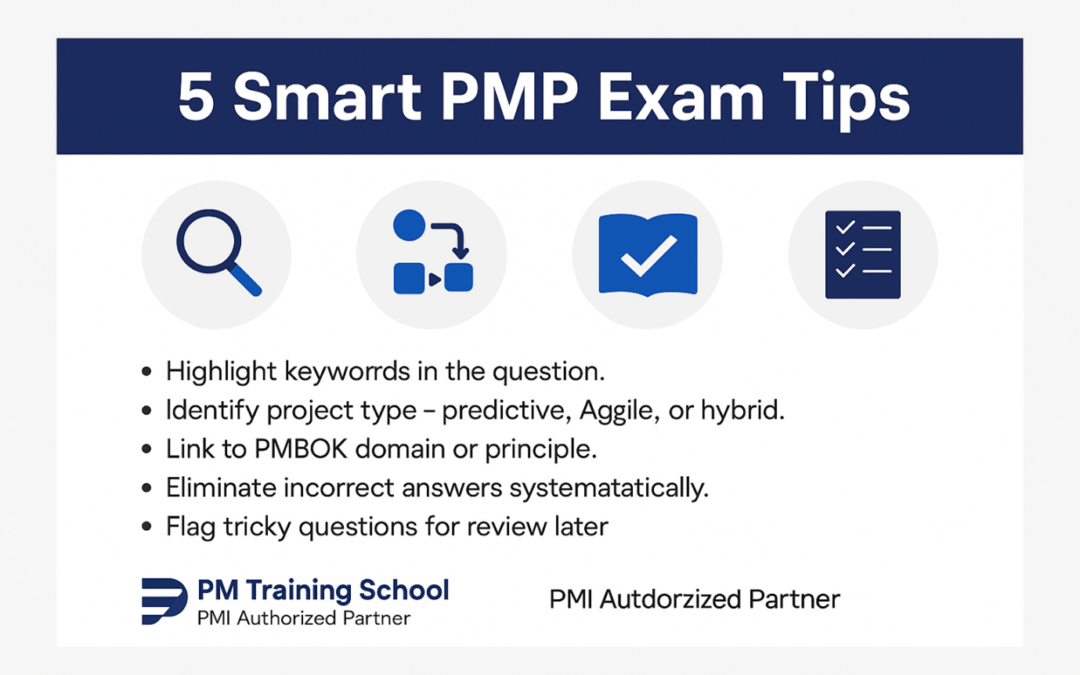
5 Smart Strategies to Pass PMP Without Extensive Study
At PM Training School, we’ve guided thousands of professionals to success. Our top five strategies:
-
Spot the Keywords
Every PMP question contains clues — “risk” vs. “issue,” “sponsor” vs. “stakeholder.” Train your eye to catch them. -
Identify the Project Type
Is the scenario predictive, Agile, or hybrid? Correct context unlocks the correct principle. -
Map to PMI Principles
Align each question with the right domain (risk, governance, stakeholder, value). PMI rewards principle-driven answers. -
Eliminate, Don’t Guess Blindly
Cross out clearly wrong answers first. With fewer choices, the odds — and your logic — improve. -
Flag and Return Later
Don’t stall on tough questions. Mark them, move on, and return with fresh perspective (often hints appear in later items).
These strategies save time, reduce stress, and shift focus from brute memorization to PMI-style thinking.
Common Mistakes That Lead to Failure
We’ve also seen patterns of failure:
-
📚 Over-studying, under-practicing. Reading PMBOK cover to cover without mock exams is a dead end.
-
🚫 Ignoring Agile/hybrid concepts. Fatal mistake, since they form half the test.
-
⏳ Poor time management. 180 questions in 230 minutes = strict pacing required.
-
🎓 Treating PMP like school. This is not academic recall — PMI wants practical judgment.
Why Choose PM Training School (PMTS)?
Not all PMP prep is equal. PMTS offers:
-
✅ PMI Authorized Training Partner (ATP) – curriculum fully aligned with the latest ECO.
-
🌐 Global expertise, local support – serving NZ, Australia, and worldwide.
-
👩🏫 Expert instructors – practicing project managers, not just trainers.
-
🧩 Scenario-based training – mirrors real exam challenges.
-
💻 Study portal & exam simulators – among the world’s most realistic.
-
🤝 Community accountability – WhatsApp & Teams study groups with peers.
FAQs
Q1. Can I really pass the PMP without months of study?
Yes — if you focus on understanding PMI principles, practicing with realistic simulators, and mastering exam strategies. Hours of rote memorization are not required.
Q2. How important is Agile for the PMP exam?
Extremely. Over 50% of questions involve Agile or hybrid methods. Even traditional project managers must know Scrum, Kanban, and adaptive practices.
Q3. Do I need to read the entire PMBOK® Guide?
No. PMBOK is a reference, not a study manual. Use it strategically; rely on curated training and practice exams for effectiveness.
Q4. How many practice questions should I complete before the exam?
We recommend at least 1,000–1,200 quality practice questions in simulator conditions to build pace and PMI-style thinking.
Q5. Is PMP worth it in 2025?
Absolutely. Demand for certified PMs is increasing globally, and PMP remains the most portable, recognized credential.
Conclusion
You don’t need to drown in textbooks to earn your PMP. With smarter strategies, principle-driven preparation, and the right partner, you can pass confidently — and step into global leadership roles.
👉 Follow PM Training School on LinkedIn for ongoing insights into project management, certification updates, and corporate training strategies.

Recent Comments